
Criminal Cases in the Canyon County Courts
Canyon County belongs to Idaho's Third Judicial District. The Magistrate Division handles misdemeanor cases, infractions, first appearances, and felony preliminary hearings. If a felony advances after probable cause is found, it moves to District Court. Idaho does not use a separate city criminal case database for Nampa, Caldwell, or Middleton. The Canyon County Prosecuting Attorney handles felonies countywide and also prosecutes misdemeanors and infractions for those cities, other named county cities, and unincorporated areas.
The clerk is the custodian of the judicial file. Public case metadata can appear in the Idaho iCourt Portal, yet a screen result is not the whole file. The clerk counter supplies access to documents that are open under Idaho court rules. That makes the filing court and case number more useful than an arrest date alone.
Canyon County Court Records in Room 201
The primary document counter is at the Canyon County Courthouse, 1115 Albany Street, Room 201, Caldwell, ID 83605. Court Operations lists 208-454-7571 and weekday hours of 8:00 a.m. to 4:30 p.m. This is distinct from the clerk's administrative address on 11th Avenue and from Sheriff Records in Room 137. Asking at the right counter prevents a police-report request from being mistaken for a court-file request.
The Canyon County Clerk page shows the office that supports District Court records. The official clerk view below helps identify the local custodian. It is the office to consult when online information lacks a document or when a certified copy is needed.
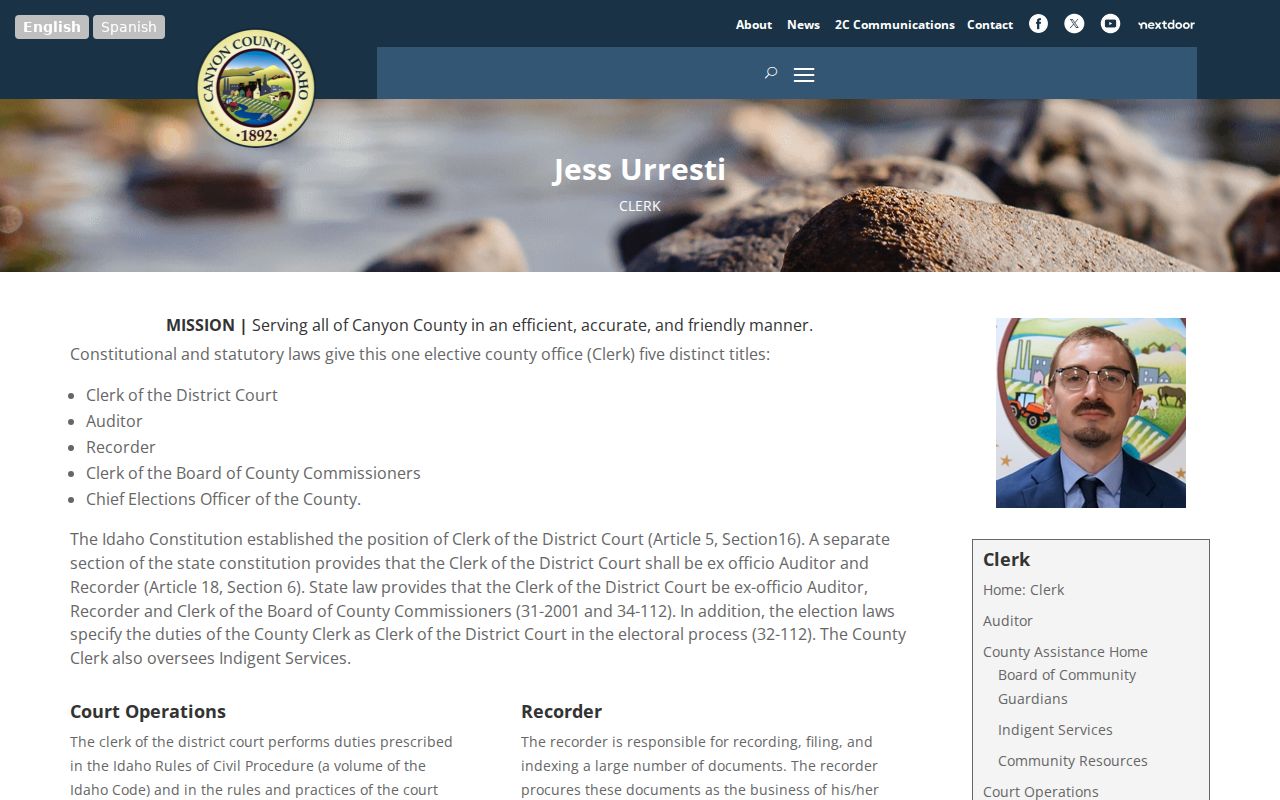
The clerk source connects the case search to the office that maintains the filed record, not to the agency that made an arrest.
How to Search Case Records
Begin with iCourt for statewide general case data, but use the Canyon clerk when the goal is a pleading, order, audio record, or certified judgment. Idaho Courts says case documents are available through a courthouse kiosk or a request to the clerk where the case was filed. The daily county calendar is another useful source for scheduled proceedings, not a substitute for the historical docket.
- Open iCourt and search general case information by the identifiers the current public interface accepts.
- Use the case number when known. If searching a name, compare the filing county and case details carefully.
- Read the register of actions for the complaint, hearings, pleas, motions, judgment, and sentence.
- Check the Canyon daily calendar when the question concerns a scheduled local proceeding.
- Use the courthouse kiosk or submit a focused request to Room 201 for copies, audio, or certification.
| Field Label | Type | Required | Notes |
|---|---|---|---|
| Party name | Text | No | Compare identity and filing county; a name alone is not conclusive. |
| Case or record number | Text | No | The strongest route to one docket when it is known. |
| Court and county | Filter/result | No | Confirm Canyon County and the correct Magistrate or District Court matter. |
| Case type and status | Filter/result | No | Public options can change as iCourt develops. |
| Filed date | Date/result | No | Helps separate cases involving similar names. |
Why iCourt Is Canyon County's First Stop
iCourt brings general Idaho case information into one statewide search. It helps when a case began with a city police agency but was filed in Canyon County court. Still, the public portal is an index and docket tool, not a promise that every pleading can be downloaded. Sealed content, protected data, and documents held for kiosk or clerk access remain outside the ordinary screen view.
The official Idaho iCourt search shown below is the starting point for public case metadata. The portal may evolve, so readers should follow the live field labels rather than depend on a fixed list of old controls.
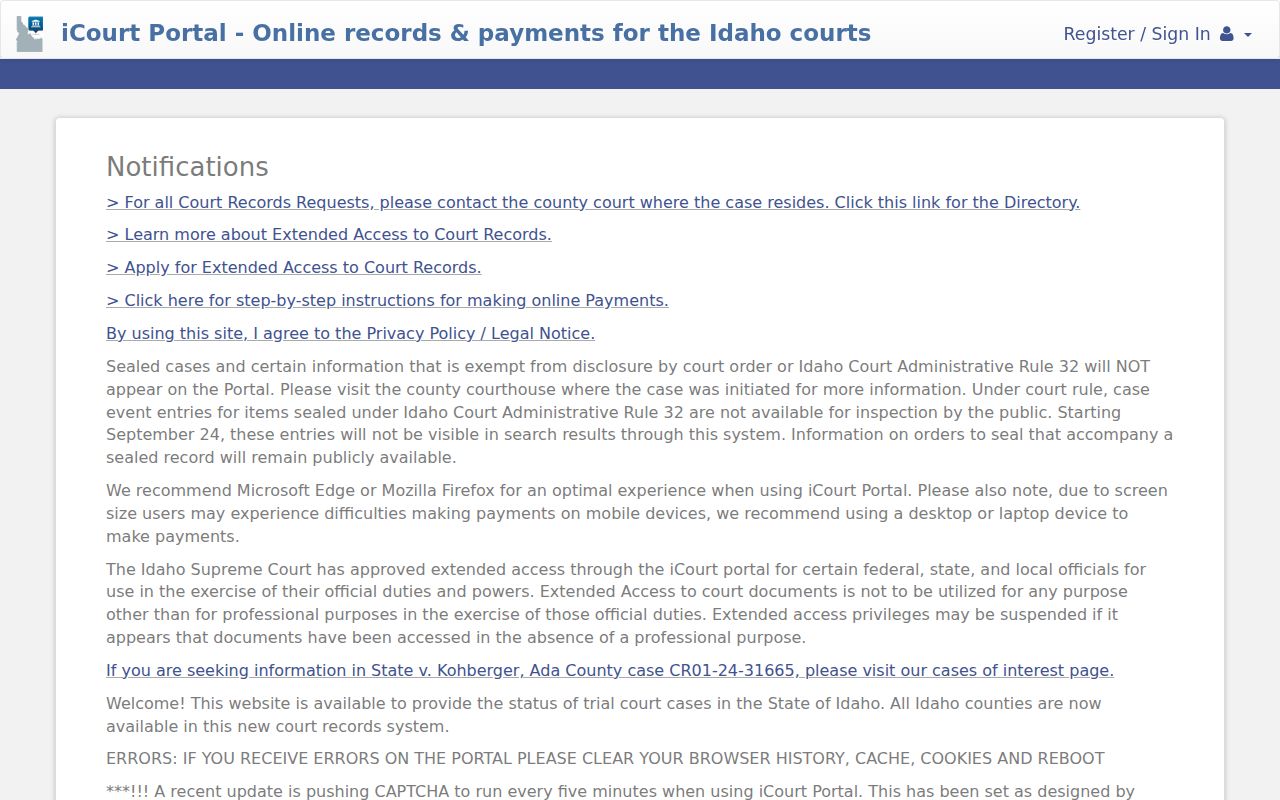
When a docket entry names an order or filing that is not open online, note its date and title for the Room 201 request.
What the Case File Shows
A Canyon County criminal case file follows the charge as filed, not merely the charge recorded during booking. Public metadata may identify the case, parties, counsel, statutes, hearings, financial entries, and the final disposition. The register of actions is the dated event list. It can show when a complaint, information, plea, motion, judgment, or sentence entered the record.
| Case Number & Court | Identifies the Canyon filing, court division, case type, filed date, and status. |
|---|---|
| Charging Document | Shows the complaint, information, or indictment and the statutes charged. |
| Docket Entries | Lists filed papers and court events in date order. |
| Hearing Dates | May show date, time, hearing type, and judge where public. |
| Disposition & Judgment | Records pleas, dismissal, acquittal, conviction, or other court outcome. |
| Sentence & Conditions | May show custody, probation, fines, fees, restitution, and entered conditions. |
Reading Canyon County's Daily Court Calendar
The county's daily calendar answers a narrow question: what proceedings are scheduled locally. It is useful for checking a date or hearing type, but it does not replace the register of actions and does not prove a final result. A setting may change, and a calendar entry may offer less context than the case file.
The official Canyon County Court Calendar is pictured below. Match any calendar result back to iCourt and the clerk file before drawing a conclusion about the case.
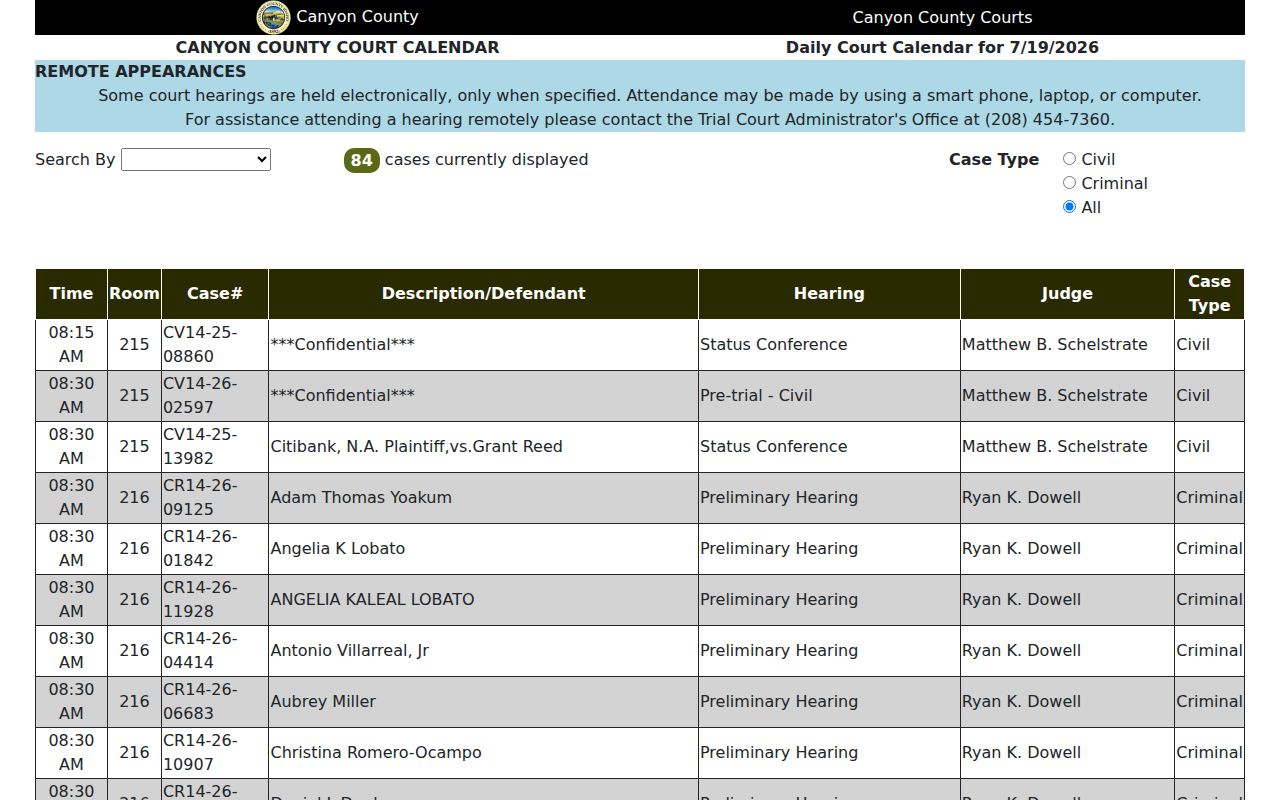
The calendar is best used beside a known case number, since names and settings alone can be ambiguous.
Stages of a Criminal Case
An investigation is referred to the Canyon County Prosecuting Attorney for a probable-cause decision. Formal charging can begin by complaint or grand jury. A felony starts its court path in the Magistrate Division, including the preliminary-hearing stage, before moving to District Court if probable cause is established. A misdemeanor remains in the Magistrate Division. Plea talks, motions, trial, judgment, and sentencing create separate docket events.
Case flow: Charges Filed › Arraignment › Pretrial › Plea or Trial › Disposition › Sentencing
Canyon's prosecutor notes a six-person misdemeanor jury and a twelve-person felony jury, both requiring unanimity. The docket should be read in sequence because an early charge does not predict the final judgment.
Canyon County Case Copies and Review
The Canyon Court Records Request asks for requester details, case number, case caption or party, exact documents or a date range, and whether the request is for copies, viewing, or audio. Narrow terms help the clerk identify the desired record. A custodian judge may review access and can limit email delivery or audio release.
Published charges are $1 per page, $1 for each certification seal, and $10 for an audio disk or digital link, plus postage and a 3.5 percent card fee. The form states that nonpayment within ten business days closes the request. The Idaho Courts record-access explanation below distinguishes general iCourt information from courthouse and clerk document access.
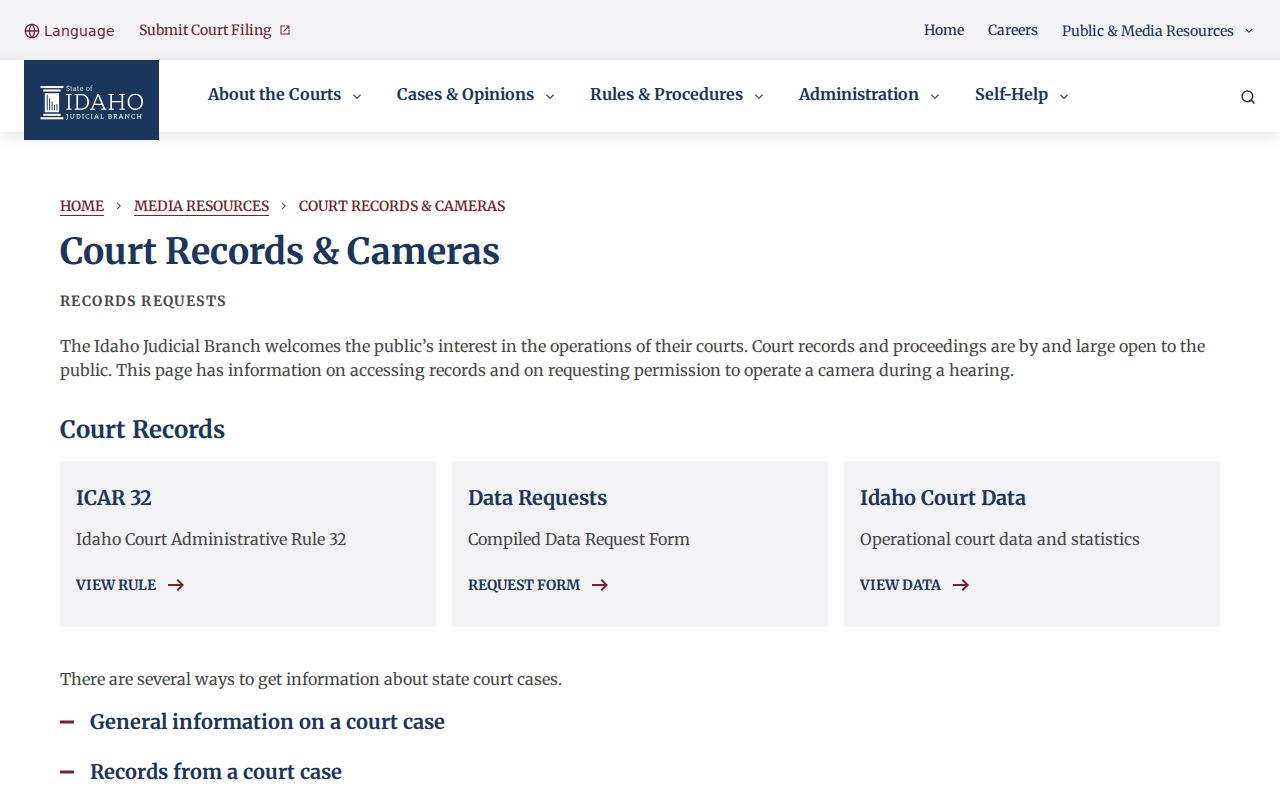
That channel split is why a missing online PDF does not mean the underlying court document is unavailable.
Canyon County Specialty Court Docket Events
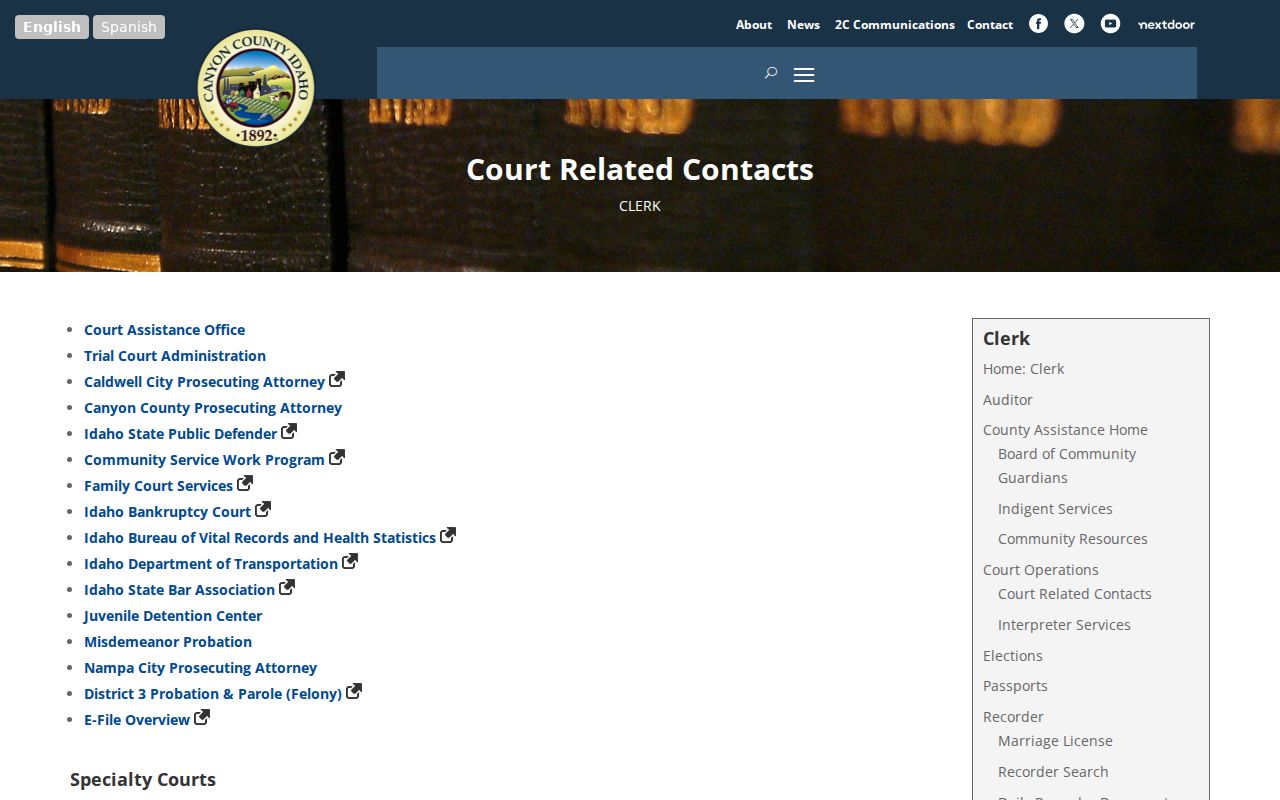
Canyon County Court Related Contacts names Drug Court, Mental Health Court, and Youth Court. County misdemeanor probation also connects with DUI, Veterans, and Domestic Violence courts. Participation can create hearings, orders, and supervision events in a case record. It does not make confidential treatment details public.
The Court Related Contacts directory shown below routes readers to the named programs and court services. Drug Court is listed at 208-455-5993, Mental Health Court at 208-455-6006, and Youth Court at 208-870-4783.
A program name in the docket should be read as part of the court process, not as a public medical or treatment record.
Access & Restrictions
Idaho Court Administrative Rule 32 governs judicial records. It recognizes public access while restricting sealed or shielded matters, protected personal data, and categories such as juvenile, adoption, mental-health, and victim-identifying information. The Idaho Public Records Act does not replace the court rule for judicial files.
If a Canyon County case does not appear online, confirm the spelling, case number, and filing county, then ask the Room 201 clerk whether the record is kiosk-only, restricted, or subject to custodian review. A redacted public view is not evidence that the court lacks a fuller protected file. The court record also differs from the arrest publication, which warns that booking charges may change.